
The Economists
It all goes way back. I thought maybe all the way back to Adam Smith, but then I was thinking about that Frenchman Bastiat; was he the first guy? Nope. Ends up this whole economics thing goes way, way back with the first extent fully developed economics text being written in Greek; it’s a poem in Dactylic Hexameter, (of course it is!). It's 828 lines long called “Works and Days”, written in the 8th century B.C. by Hesiod, a farmer poet.
Here's a poem written something like 2,700 – 3000 years ago, and astoundingly, it is totally extent! This is a time before the rise of Athens – this is a long, long, time ago and people from that time and subsequent people kept this poem alive by recopying it and retelling it. It’s a gem. Here are some excerpts:
The gods keep hidden from men the means of life,
Otherwise, you would easily do work enough in one day
to supply you for a year without working
Works and Days, lines 42 through 45.
The virtue (aretë in Greek) of hard work is stressed:
Through work men grow rich in flocks and substance,
and working they are much better loved by the immortals
He who puts off work with idle sits,
waiting for his neighbor, lacks bread.
Works and Days
And from all that virtuous hard work, you will avoid scarcity and be able to enjoy life.
If your soul inside your mind craves wealth,
do as I say, and one work after another work undertake.
With works men get a big herd and become rich
to enjoy the means of life taken from inside your house
thriving reaching the bright spring,
looking without others who will have your need.
Works and Days, excerpts
As the year progresses for the hard-working soul, comes that season of late summer say mid-August:
When the golden thistle is in flower, and the
noisy cicada sitting in the tree pours down its
clear song thick and fast from under its wings
in the fatiguing summer season, then goats are
fattest and wine is best, women are most
lustful, but men are weakest, because Sirius
parches their head and knees, and their skin
dried out with the heat. Then you want rocky
shade and Bibline wine, a milking cake and
the goats’ last milk, and meat of a scrub-
grazes cow that has not yet calved, and of
firstling kids. And after it you want to drink
gleaming wine, sitting in the shade, having
had the heart’s fill of food, facing into a fresh
westerly breeze. From a perennial spring that
runs away and is unclouded pour three
measures of water, and the fourth of wine.
Works and Days
Man, oh man, Summertime and the livin’ is easy… Daddy’s rich and your Mamas’ good lookin’, so hush little baby don’t you cry.
“It is really amazing for a village man like Hesiod to give such a description. Not only must people work hard to acquire the scare means of life but enjoy consuming them along with other pleasures that usually the scarcity of means cannot buy.”
Economics is the study of scarcity; and scarcity (and how to avoid it) is the topic of the first fully extent text on economics. I’ve also heard the definition: “Economics is the study of scarce resources, and unlimited desire.”
If that were the end to it, there wouldn’t be much more to say. But the subject of economics has become increasingly prominent in shaping perceptions of society, particularly since the late 19th century. Historically, since Hesiod, to me relatively few economic concepts have proven to be broadly useful or even true. There’s been a tendency to overestimate the contributions of economists.
Look at the status of Economists in government and finance – they’re the advisors to our modern-day kings and emperors, and the oligarchs of finance with world-wide wealth and technology far surpassing what our farmer-poet Hesiod could have ever imagined. Economists fill the role of the wise-man and advisor to the powerful much as the wise men and astrologers of past times.
And they are quite proud of themselves, these worldly philosophers. There are schools of Economists,
the Austrian School,
the Chicago School,
the Marxist Economists,
Keynesians,
and on and on.
Did I mention? They all disagree with each other on just about everything. And after reading Hesiod, I am starting a school of Economics called the Hesiodians. What is going on?
I studied Financial Analysis in College and had to take two semesters of Economics as part of the curriculum, and I must admit they weren’t my favorite classes. The only class worse than Econ was Accounting and I had to take two semesters of that too. Miserable. And please do not be dissuaded from studying Business in college – I highly recommend it as a course of study. Marketing, Money and Banking, (how banks function simply blew my mind…), Financial Analysis, Management, Organizational Behavior, the list goes on. Business is a fascinating course of University or college study and by all means, if you have the chance, study Business.
Economics? Outside of my new school of Econ, the Hesiodians, it’s close to 100% humbug, floobydust, and nonsense. Here’s why.
Again, we need to back up just a bit. You see, prior to studying Business, I studied Philosophy; and stated assumptions at the beginning of a train of thought will always catch the philosopher’s eye. And here’s what I got off page 1 (at least it was page 1 in my mind) of the assumptions of the study of Economics:
Economics is the study of scarcity (as a Hesodian, I’ll buy it)
Economics does not define “value” but only price (cash)
And later I found out that:
Economists do not agree on the velocity of cash
We’re going to elaborate and break this all down and we’ll start with a descriptive tale on monetary velocity.
Right after the fall of the Soviet Union, the commercial markets there were in a state of shall we say, flux. Maybe chaos is a better word, and carpetbaggers from around the world were showing up to, well, do business. One such sort, an American businessman found himself at a hotel in Moscow checking out a room to see if it was up to his standards.
He walked up to the hotel lobby and said to the clerk,
“I’m not renting a room unless I get to check it out first.”
The clerk replied,
“Oh course. I’ll have someone take you to room, but first deposit 100 ruble refundable security fee”
The businessman digs into his wallet and pulls out a 100 ruble note that he had specially marked with a small ink symbol in one corner of the note to make sure if he wanted the note back, it would be the original and not potentially a counterfeit. He gives it to the clerk and the porter escorts him to the elevator. The moment the elevator door closes on them, the clerk shoves the 100 ruble note into his assistant’s hand and hisses:
“Run to plumber across street and tell him fix toilets now!”
The plumber gets the note, says he’ll be there right away, stops by next door and gives the 100 ruble note to the plumbing shop owner for parts he owed money on, then goes to the hotel with a plunger and a drain snake.
The plumbing shop owner gets the note and without even putting it in the cash register, crosses the street and gives the 100 ruble note to his favorite female escort standing around the hotel entrance he owed her for last week’s affair.
She saunters into the hotel lobby just as the elevator door is opening on the businessman and glides behind the counter standing shoulder to shoulder with the clerk, she tickles his finger under the counter and slips him the 100 ruble note for the back charges on the room she’s been using for her hospitality business as the businessman marches up to the lobby counter and slaps both hands down and demands:
“I want my money back! That room’s a dump! I’m not staying.”
No sooner had the note left the escort’s hand into the clerk’s hand than he offered it to the now agitated businessman who grabbed it and held it up to the light and scans it until he finds the telltale symbol and then pockets the note. The two exchange dirty looks and the businessman storms out.
Everybody got paid with the same 100 ruble note. And the businessman got his money back. What!?
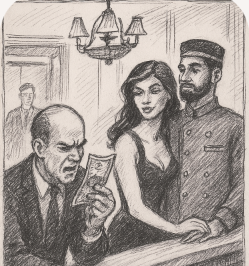
Okay, this joke’s been around for a while now, and it depends on a setting where the local economy is somehow a bit helter-skelter and the locals are functioning day-to-day on cash; but the point is, this is monetary velocity on the street level. That single 100 ruble note got spent one, two, three, four times in five minutes. That’s what I call velocity.
Between the schools of Economic Thought, there is great disparity of opinion on monetary velocity. First off, no one even knows how to measure it; and it’s clearly fundamental to a group of Thinkers who do not define value, only cash. Nevertheless, there are those who believe that aggregate monetary velocity is greater than one, like in our amusing little anecdote above, and those who do not.
Not surprisingly, these two schools are also politically aligned on opposite sides of the aisle. I believe that on even numbered years one side wins the Nobel prize for Economics and on odd years the other side. I can't keep up. My point is that neither side has any remote idea what they’re talking about.
Then there’s price (measured in currency, dollars, Euro, you name it; I call it cash), vs. value; which leads us into the philosophical tension in economics between subjective value and market price. Traditional economics mainly examines price formation based on supply, demand, scarcity, and information, without exploring deeper personal or cultural notions of value. While price shows what people will pay, value is subjective or intrinsic, a topic debated by philosophers and modeled in various bumbling ways by behavioral economists.
Classical economists such as Adam Smith differentiated between:
"Value in use" (the utility of an item)
"Value in exchange" (its trading value or price)
The water-versus-diamonds example illustrates this: water is necessary but inexpensive, while diamonds are less essential but costly. Modern economics addresses this by examining marginal utility and revealed preferences, which show how decision-making and behavior relate to value through observed market prices. Behavioral economics examines how perceived value can influence prices, sometimes leading to irrational outcomes due to factors like anchoring effects, social influence, or brand perception. As a result, while economic theory is based on pricing mechanisms, value is the shadow it can’t escape. And remember, diamonds are a girl’s best friend.
Is it any wonder that the Economists do a poor job of forecasting? Take recessions. At my last count, they predicted ten of the last three. But they missed the dates. The stock market? It’s going up. Or not. It’s effect on the economy at large? Fundamental. Or not. If you want to know good stocks to invest in, ask you congressman. They typically clean up, making a tolerable good salary, but their commodity and stock trading are what make them millions and even billions. Economists? Make me laugh.
The clown car of Economists (they keep coming! Where do they all come from?) really shifted into high gear after the Great Depression of the early 20th century and these frauds and charlatans contributed untold damage to polite society.
Of course there was a parade of early 20th century bad ideas, Eugenics, Utopianism, Occultism, Racism, blood and soil Nationalism; but all these enthusiasts, these humanity hating odd balls, weirdos, and fantasists had one thing in common: they all had some sort of Economic Explanation to Fix Everything involving total top-down planning.
Whether Nazi or Bolshevik, the idea was that in the case of political fascism “the Nation”, and the case of the commie Bolshevik, “the People” would determine the course of economic progress. In 1937 Hitler issued an order to nationalize all industry. Commies do the same thing. Eliminate ownership and nationalize it. Assume the individual into the collective or eliminate the individual. There are those with power. The rest obey.
Totalitarian central planning had hit its historic high-water mark in Italy, Germany, and Russia; but it was a worldwide craze after the depression with the Economists at the wheel. What could possibly go wrong?
In the U S of A we got FDR who put the “Great” in “Great Depression”. A growing body of scholarship is steadily showing what a horrific job FDR did, and his role in igniting WWII, uncomfortable as it is, is indisputable. You say he was “popular”? So were Hitler, Stalin and Mussolini. It was a weird time with all those brilliant intellectual ideas resulting in hundreds of millions of people murdered, butchered, gassed, nuked, burned alive.
Let’s do a thought experiment and talk about frisbees. How many frisbees should Nazi German have made in 1937? How about Russia? Well, first off, keeping in mind that this is a thought experiment, these countries didn’t have frisbees. But there’s a deeper question: Is it possible that a murderous, amoral, bloodthirsty, totalitarian state could even think up the concept of a frisbee?
Let’s leave that deeper question for now and focus on the far simpler question of how many of them to make. And now that you have an idea of what I mean by a “totalitarian state” let’s not nationalize it. Germany and Russia have been through enough. For our example, it will simply be a completely planned-economy totalitarian state. A state trying to figure out how many frisbees to make. A state run by Economists.
Don’t all these utopias have five-year plans. Yes. We’ll make “recreational items for youth” a category and assign production quotas based on hard, immutable economic realities of the State. One thing to consider is material, they’re made from plastics that may be needed for industrial or military purposes. Frisbees might get bumped down on the priority list. But after all, there could be propaganda utility and could be seen as promoting wholesome collectivist outdoor activity and that could boost their planned output.
Public schools (always a key institution in totalitarian states) or youth brigades might submit requests which might result in a plan like “X frisbees per 100 Young Pioneers” could be standardized across regions. Historic output might be important; we produced 12,000 last year so next year they target 13,000 for progressive growth. And material or labor shortages could cap production. It could be problematic. In fact, there are going to be problems.
No matter how many Economists they put on the job, and these totalitarian outfits employed them by the thousands, they’ll still end up with either too many or not enough frisbees to match real demand. What’s missing is a price signal to indicate frisbee user interest. There’s no feedback loop of sales data to calibrate production. There’s limited (or none whatsoever) room for product differentiation. The “Official Frisbee of the Democratic Republic” might be one size, one color, forever.
The number of frisbees isn’t discovered like it might be in a market, it’s assigned opening an entirely new can of worms about efficiency, waste, and whether frisbees ever end up in the right hands of kids (of all ages) who want them. It could get far worse; because, considering frisbees, that’s only a single toy. What if we add yo-yos to the mix? Yo-yos and frisbees are both classic examples of toys whose popularity waxes and wanes with cultural trends, generational tastes, and the rise of niche sports.
That “economists” and other control-freaks could ever determine how many of these two toys to produce, when, and market to whom (markets don’t exist in my hypothetical nightmare state) would defy our hapless “planners”. To get an idea of how massive the problem would be, let’s look at some general statistics for these two toys in the real world:
Frisbee
The global frisbee market is alive and growing, projected to reach 1.74 billion by 2033, with a steady CGAR of 4.7%
Disc golf has been a major driver of sales with over 14,000 courses worldwide and millions of rounds played annually.
The adult segment now dominates the market, especially in fitness recreation and competitive training.
North America leads the market share.
Yo-Yos
Yo-yos have seen a revival through social media, especially Tik-Tok, where tricks like the DNA spin have gone viral
The market is diverse and specialized, with responsive, unresponsive, off-string and counterweight styles catering to beginners and pros alike.
Brands like YoYoFactory, Duncan, and MagicYoYo continue to innovate with metal alloys, hybrid designs, and LED enhanced models
While not as big as the Frisbee market, yo-yos maintain a strong enthusiast base.
Both toys reflect how non-essential goods in a planned economy would be hard (impossible) to forecast because their demand is so taste-driven and culturally fluid. Totalitarian planned economies, and frisbees and yo-yos are simply incompatible with one another. The utopians and their economists couldn’t ever figure out how to manage yo-yo production. Pathetic.
Academic economics in America at the time frequently predicted the eventual success of the Soviet system, until its dissolution after 1989. A widely used economics textbook included a table projecting the future dominance of the Soviet system over the US market system. While acknowledging that the US market system contains elements of cronyism and lacks full openness, it was less restrictive than the Soviet system. Over multiple editions following World War II, the textbook adjusted the projected date for the Soviet system surpassing the US economy further into the future with each revision. After 1989, this table was removed from the textbook. That’s what I call intellectual honesty. Not!
This is the situation, and I think these days you are hearing less about this or that economist or this or that economic panel. They’re becoming the poster child for the image of the failed expert, and the fall of communism and generalized failure of planned economies has had a lot to do with it from an observational empirical perspective.
But I think it’s beginning to seep into people’s consciousness that there’s little to nothing to economic theory itself. They dodge a real working definition of value; I mean that water / diamonds thing just leaves me scratching my head. And velocity? It’s absolutely key to them and economists stridently disagree on it. If aggregate velocity is high (greater than 1), times are good, consumer confidence is high, and people are (by definition) spending money. What, it takes a Ph.D. to figure this out? Duh. But what if it goes below 1? How can this happen?
In bad times, people may hoard money like in a financial crisis or hyperinflation. Then demand for liquidity spikes slowing down the velocity further. Technologies like digital payments and central bank policies like quantitative easing can affect velocity without changing the underlying money stock.
Velocity is not a fixed number. It’s affected by behavior, not just math. Keynesians, Monetarists, Post-Keynesians and the entire alphabet soup of schools all interpret its importance differently with some treating it as stable and others thinking it fluctuates wildly.
“Hint: value and velocity aren’t constant; they’re artifacts of time and mood”
Hint: value and velocity aren’t constant; they’re artifacts of time and mood. A central banker (economist) designs a policy with an idealized velocity, but in a crisis, people hoard cash, and the model collapses. Similarly, value is not revealed in price alone. It’s distorted by marketing, (propaganda), emotion, nostalgia, and scarcity all are factors economics struggle to quantify. Add demographic shifts like aging populations and mass-migrations and you have a formula for economic forecasting chaos. It’s not the “dismal science” it flatteringly calls itself – it’s babbling nonsense serving the flavor of the month in utopian fantasies.
Economics as a subject is philosophy disguised as science leaning heavily on assumptions and simplifications. It is normative while pretending to be descriptive. It postures as predictive when often it should be reflective. It piles obtuse numerical models on weak and shifting definitions, quantitative yes, but conditional on assumptions that are sometimes metaphysical. The resulting models become perilous when stretched into policy or ideological defense.
Value and velocity aren’t constants in an equation; they’re philosophical variables masquerading as data points. Forget about Economics as a neutral arbiter of policy and preference, the reality is far murkier. Beneath the formalism lies a framework deeply concerned with human behavior; volatile, subjective, and shaped by sometimes dark but undeniably non-economic forces.
Before the 1930s, economics was conservative in scope focusing on trade, prices and marginal adjustments. Post depression, figures like Keynes stepped forward with sweeping visions: governments could manage aggregated demand, engineer employment levels and tame the boom and bust of the business cycle. Keynesians and other schools of Economists achieved a kind of quasi-priestly status in policy circles moving far beyond merely interpreting the economy They were redesigning society.
Enter Karl Marx (again). He was from an earlier time, but his quaint idea of “class struggle” was refashioned to address the problems of the Great Depression, and his whacky fever-dream version of historical analysis, seeped in deeply racist, narrow Teutonic clap trap, gained new traction. His warnings about the internal contradictions of the day seemed to echo through breadlines, shuttered factories and shattered lives. The period directly after the Great Depression was the dawn of the era of the Economist.
Economists became agents of ideology more propagandists than effective planners – they couldn’t even manage yo-yo production in a totalitarian system where they’re influence on practical government was near total control. Five-year plans. Quotas. National Socialist Germany; the Soviet Union; virtually every totalitarian nation of the era fell apart after a few, or a few more decades. All the kings horses and all the kings men couldn’t figure out how to run a nation with a planned economy.
The role of economists today isn’t yet shattered but is showing fracture. They’re still whispering in the ears of the central bankers, still forecasting, advising, but their credibility has been dented by financial crisis, (after crisis), inflation and interest rate misses and misreads, and more fundamentally by the ongoing theoretical fragmentation of their most basic assumptions.
They’re losing public trust with the idea of the “neutral” economist under siege. Once the humble clerks of commerce, economists emerged from the Great Depression reimagined as engineers of Fate. The shift was fueled by Keynes and legitimized by Marx. But as their models age and assumptions crack under the complexity of reality, economists stand now less as seers and more as sophists, surrounded by uncertainties they can describe but not tame.
Gregory Olsen, Tempe, Arizona 2025
